Decoding Siemens MLFB order numbers for Sinumerik spares
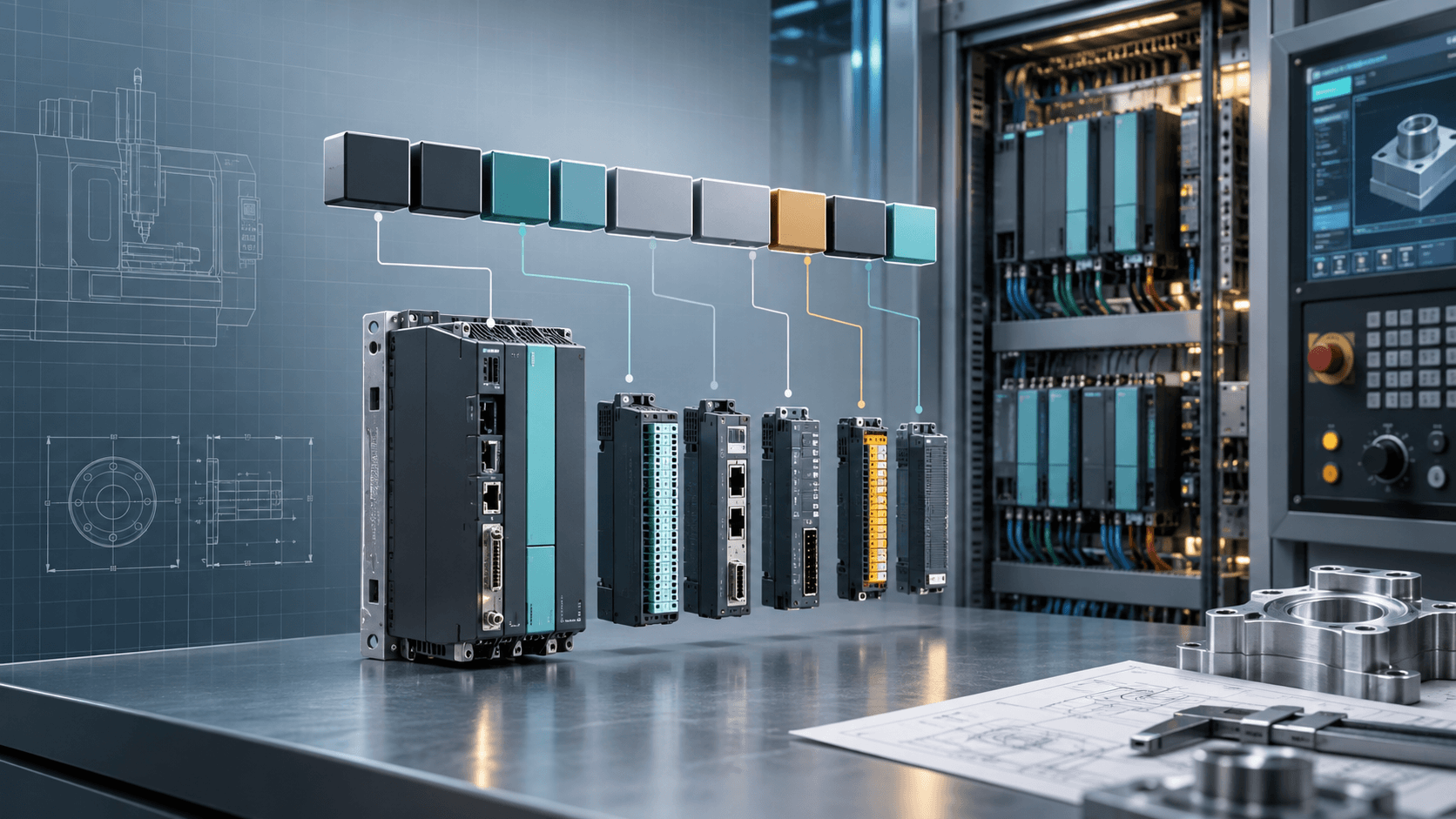
The MLFB (Maschinenlesbare Fabrikatebezeichnung) is Siemens' machine-readable order designation. It is the only identifier worth quoting from.
Find the MLFB, then find the version
Siemens rating plates carry an MLFB — the machine-readable product designation — alongside a serial number and, on most electronics, a hardware version or 'Erzeugnisstand'. On drive and control hardware the MLFB is typically a 6-prefixed string in groups separated by hyphens; motor-family and drive-family products use different leading groups.
Two Siemens units with the same MLFB but different version markings are usually interchangeable for the hardware function, but not always for firmware compatibility inside a system that expects a particular level. Record both. If a supplier only asks for the MLFB and never asks what system it is going into, that is a warning sign rather than efficiency.
Siemens is unusually good about keeping order numbers stable across long production runs, which is why the MLFB is such a reliable key. It is also why a superseded MLFB usually has a documented successor — worth asking about explicitly if the original is no longer produced.
Reading the structure
An MLFB is positional: the leading characters identify the product group and family, the middle groups narrow the specific type within that family, and the trailing group after the final hyphen encodes the variant — rating, interface, option content. As with Fanuc, the variant tail is where interchangeability is won or lost, so never quote a partial MLFB.
Some Siemens products additionally carry Z-options: a -Z suffix followed by short option codes indicates factory-fitted options on top of the base type. If your plate shows a -Z and a list of codes, transcribe those too. A base unit without the Z-options is a different item, and for motors in particular the options can cover the encoder, brake and connector orientation.
Sinumerik generations behave differently
Sinumerik 810D and 840D (the powerline generation) build around an NCU module in a drive rack with Simodrive 611 digital drive modules. Sinumerik 840D sl (solution line) is a different architecture built on an NCU with Sinamics S120 drive modules. Parts do not cross between those worlds, so state which generation you are running before anything else in an RFQ.
Within a generation, the pieces that fail most and are asked for most are the NCU itself, the operator panel and its PCU, the drive and motor modules, the line/infeed module, and the measuring-circuit or feedback hardware. Each has its own MLFB — quote them individually rather than describing 'the drive rack'.
Data retention is the trap specific to this family. Machine data, PLC program and compensation tables live on the control, and on older generations they are held with battery-backed memory. Before you swap an NCU, take a full series start-up archive. A replacement module is useless if the machine's own configuration went into the skip with the old one.
What to send with the enquiry
The MLFB, the version/Erzeugnisstand marking, the Sinumerik generation, and the machine builder and machine model. If the part is a motor, add the connector orientation and whether it has a holding brake, because those are option-coded and are not always obvious from the MLFB alone.
Photographs of the plate and of the installed unit in place are worth more than a paragraph of description. Attach them to the quote request and a supplier can confirm the variant instead of asking three rounds of clarifying questions.